Style · 7 min read
The Retro Kit Revival: Why 90s Designs Are Back
Geometric prints, oversized collars, and electric colours — the nineties are dictating what shirts look like in 2026.
Futbol Shop Editorial · February 4, 2026
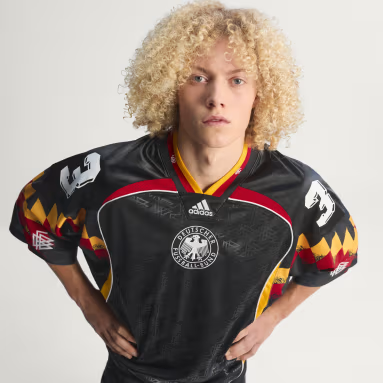
Walk down any street in São Paulo, London, Tokyo, or Mexico City and you'll spot 1990s-style football shirts being worn as everyday fashion. The trend has fully crossed from collector circles into mainstream streetwear, and the major manufacturers have responded with a wave of reissues, anniversary releases, and new designs that openly borrow from three-decade-old templates.
What's driving the comeback
- Bold print culture rebelling against minimalist 2010s design
- Vintage resale platforms making rare originals visible to a new generation
- Brands re-releasing classic templates with modern fabrics
- Players being photographed off-pitch in vintage kits
- Music and fashion crossover — rappers, indie bands, and runway shows all featuring vintage shirts
The 1990s were the most experimental decade in football kit design. Manufacturers had just discovered sublimation printing, fabric technology was improving fast, and federations were less protective of their identity than they are today. The result was a window of perhaps eight years — roughly 1992 to 2000 — where shirts could feature anything from full-shirt geometric explosions (Germany 1994) to literal landscape paintings (Mexico 1994 goalkeeper) to tessellating brand logos (Arsenal 1991-93).
By the mid-2000s, this experimentation had been almost entirely scrubbed out. Federations standardised on cleaner templates, sponsors got more conservative, and the dominant aesthetic became a single base colour with a single contrast trim. That minimalism held for nearly two decades — and the 90s revival is, in part, a generational reaction against it.
The originals vs the reissues
If you're starting a collection, you'll quickly run into a choice between original 1990s shirts and modern reissues of the same design. Both have a case.
Originals carry genuine history — they were on the pitch, they're often hand-stitched in ways modern manufacturing has abandoned, and the cotton-blend fabrics of the era have aged into a softness that can't be faked. The downsides are real: sizing was inconsistent, condition varies wildly, and a mint-condition rare shirt can run into four figures.
Reissues offer the design without the fragility. Modern fabrics are more durable, sizing is standardised to current expectations, and the price is a fraction of an original. Some collectors find them inauthentic; others see them as the only practical way to actually wear a design from thirty years ago.
Where to start a collection
Pick one team you genuinely care about and build outward — a 1994 Brazil home, a 1998 Nigeria away, or a 1996 Germany Euros. Original cotton-blends are forgiving on most body types, and the prints look better with age. Don't try to assemble a comprehensive collection in your first year; the shirts you buy thoughtfully tend to outlast the shirts you buy quickly.
Authentication matters more in the vintage market than the new market. A 1994 World Cup shirt that has obviously been re-printed or re-stitched is worth a fraction of a clean original. Buy from sellers who provide detailed photos of the wash labels, badge backings, and any stitching on the inside hem — those are the details that separate a real shirt from a reproduction.
Designs to watch in 2026
Several manufacturers have signalled 90s-influenced designs for the post-World-Cup release cycle. Adidas's Originals line continues to mine the Equipment-era templates, and Nike has hinted at a series of 1996 Euros reissues. Puma's collaboration line with vintage-football publications has produced some of the most desirable releases of the past two years.
Browse our retro collection for ready-to-wear reissues that capture the era without the fragility of a thirty-year-old shirt.